

A cluttered garage doesn’t just waste space. It makes every project harder, every search for a tool longer, and every attempt to park your car an exercise in frustration. The good news is that most garages have far more usable storage potential than they appear to.
After helping thousands of homeowners clear out their garages, our crews have seen what works and what doesn’t. Whether you have a sprawling three-car garage or a tight single-car setup, the ideas in this guide will help you build a system that actually sticks.
Best Garage Storage Ideas:
Click to auto scroll by section.
1. Clear Out Before You Organize
The most common mistake people make is buying storage solutions before sorting through what they already have. New cabinets and wall systems won’t help if they’re filled with things you no longer need.
Start with a full sort. Pull everything out and divide it into three piles: keep, donate, and toss. Be honest. If you haven’t used it in two years, you probably won’t. The items our crews most commonly haul out of garages include:
- Broken or duplicate tools
- Old paint cans and dried-up sealants
- Sports gear that no longer fits anyone in the household
- Seasonal decorations that haven’t seen daylight in years
- Broken appliances or exercise equipment waiting to be dealt with
- Boxes of mystery items moved from a previous home
For hazardous items like old paint or chemicals, Earth911 can point you to a safe disposal location nearby. Once you’ve cleared things out, you’ll have a much better sense of how much storage you actually need and what kind.
2. Cabinets
Cabinets are the foundation of a clean, organized garage. They hide the mess, protect your gear from dust and moisture, and give the space a finished look that open shelving can’t match.
What to look for:
Not all garage cabinets are built the same. Here is what matters when choosing a system built to last:
- Material: Heavy-gauge steel is the most durable option for heavy tools and chemicals. Solid wood works well in climate-controlled garages but can warp in extreme heat or humidity. Avoid lightweight particleboard, which won’t survive a demanding environment.
- Weight capacity: Look for shelves rated at 200 lbs or more if you’re storing power tools, hardware, or automotive supplies.
- Adjustable shelves: Fixed shelves limit you over time. Adjustable shelving lets you reconfigure the layout as your needs change.
- Locking doors: Worth having if you’re storing chemicals, sharp tools, or anything that shouldn’t be accessible to kids.
- Modular systems: Brands like Gladiator, Husky, and NewAge let you start with a few pieces and expand over time without replacing what you already have.
Wall-mounted cabinets keep the floor clear and make the space easier to clean. Freestanding units offer more flexibility if you think your layout might change.
3. Wall Storage
Garage walls are some of the most underused storage real estate in any home. Getting items up and off the floor, where they’re visible and within reach, is one of the highest-impact changes you can make to how a garage functions day-to-day.
Options worth considering:
Pegboards are flexible, affordable, and easy to rearrange. A 4×8 sheet with a set of hooks and baskets can organize an entire wall of hand tools, cords, and small accessories for well under $100.
Slatwall panels are a step up in durability and load capacity. They accept interchangeable accessories including hooks, bins, shelves, and bike holders, so the system can grow and change as your needs do.
French cleats are a favorite among serious DIYers. The interlocking angled strips let you hang custom tool holders, shelves, and bins anywhere along the wall. The setup is strong, reconfigurable, and costs very little to build yourself.
Hooks and racks are the simplest option for bikes, ladders, long-handled tools, and extension cords. A handful of well-placed heavy-duty hooks can clear a surprising amount of floor space in under an hour.
4. Shelving: DIY to Ready-Made
Shelving is the workhorse of most organized garages. It is sturdy, versatile, and holds a lot. Whether you buy a unit or build your own, adding the right shelving dramatically increases how much your garage can actually store.
Ready-made options:
Freestanding metal shelving is the most popular choice. Units are affordable, easy to put together, and come in a wide range of sizes. For general use, look for at least 250 lbs per shelf. If you’re storing heavy automotive or landscaping equipment, go with 400 lbs or more.
Wire shelving allows air to circulate, which helps reduce moisture buildup on stored items. Solid steel decking is better for heavy or oddly shaped things that would fall through the gaps.
Building your own:
DIY shelving from dimensional lumber is one of the most cost-effective upgrades you can make. A basic wall-mounted shelf runs about $30 to $50 in materials and, when anchored into studs properly, can hold several hundred pounds.
Building your own also means you can fit the shelves exactly to your space, something you can’t do with a store-bought unit. If you want step-by-step plans, Family Handyman has several well-documented shelf builds worth looking at.
5. Ceiling Storage
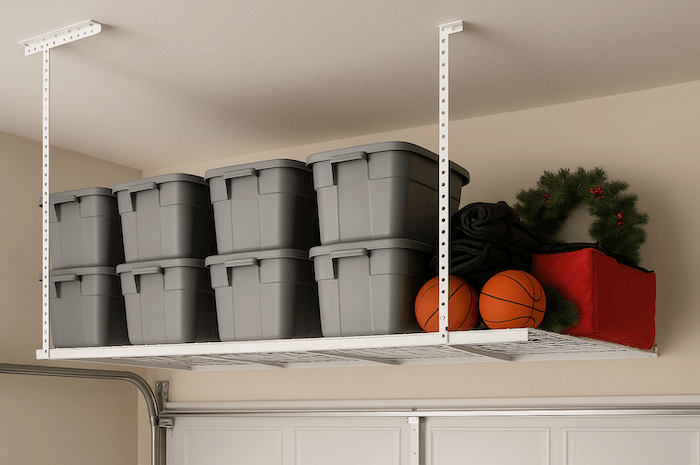
The area above your car, typically 8 to 10 feet off the ground, is often completely wasted. Ceiling storage is one of the best ways to add capacity without touching a single wall or claiming any floor space.
Overhead racks:
Overhead racks mount to the ceiling joists and typically hold 400 to 600 lbs. Most are designed for standard 8-foot ceilings and can be adjusted in height to clear your car roof or garage door track.
Reserve this space for items you rotate seasonally: holiday decorations, camping gear, luggage, and sports equipment you use a few times a year. Anything you reach for weekly doesn’t belong up there.
Building your own overhead platform:
A DIY ceiling platform made from 2×6 lumber and plywood can be built for under $150. The key is securing it to ceiling joists, never to drywall alone. If your joists run the wrong direction for your layout, a structural ledger board can redirect the load.
Storage lifts:
For heavier items like kayaks, canoes, or large bins you access a few times a year, a motorized or pulley-based lift is worth the investment. It takes the physical effort out of the equation and makes ceiling storage genuinely practical.
6. Affordable and DIY Ideas
You don’t need a big budget to get your garage under control. Some of the most effective upgrades cost very little and just take an afternoon.
- Lumber shelving: A wall-mounted 2×4 and plywood shelf costs about $25 to $40 in materials and is one of the strongest setups you can build.
- PVC pipe tool rack: Short sections of PVC pipe mounted horizontally on a board create a simple, effective rack for rakes, shovels, and brooms. Total cost is under $20.
- Repurposed kitchen cabinets: Old upper cabinets are often free or very cheap and work perfectly on a garage wall for small tools, hardware, and supplies.
- Magnetic strips: A magnetic tool strip at eye level keeps screwdrivers, chisels, and small metal tools visible and easy to grab.
- Wire shelving on clearance: Standard wire shelving units from Home Depot or Lowes frequently go on clearance for $30 to $50 and are solid enough for most storage needs.
- Labeled bins: Consistent labeling costs almost nothing and makes a bigger difference than most people expect. When everyone in the household knows where things go, the system tends to hold.
The thread connecting all of these is vertical space. The more you get off the floor, the bigger and more functional the garage feels, whatever your budget.
7. Bins and Containers
The right containers make the difference between a shelf that stays tidy and one that slowly descends back into chaos. A little consistency in size, style, and labeling goes a long way.
Heavy-duty stackable bins are the most reliable option. Look for bins rated for at least 50 lbs with latching lids. Iris, Sterilite, and Rubbermaid all make options in standard dimensions that stack cleanly, which matters if you’re using overhead racks or deep shelving.
Clear vs. opaque: Clear bins let you see what’s inside without opening them, which is ideal for things you access regularly. Opaque bins are fine for seasonal items where a label is all you need. A mix of both is usually the most practical approach.
Purpose-fit containers: Sports gear, automotive supplies, and garden chemicals each do better in containers sized for those items rather than generic all-purpose bins. A deep bin for balls, a shallow tray for spray cans, a lidded container for fertilizers. Purpose-fit containers tend to stay organized longer.
Whatever containers you choose, label them. It sounds obvious, but consistent labeling is the single habit that keeps any storage system working over time.
8. 1-Car Garage Tips
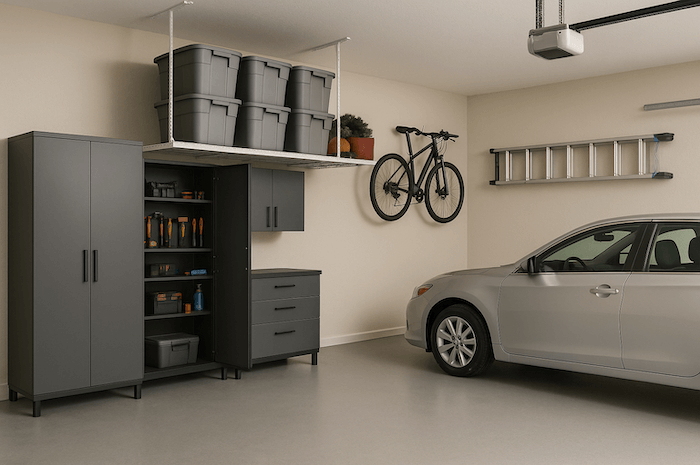
Organizing a single-car garage comes with a real challenge: you want enough storage to make the space useful without pushing the car out entirely. The answer is almost always to go vertical and to be selective about what actually belongs in there.
What works in a tight space:
Use the full ceiling height. Overhead racks above the car’s roofline can add 40 to 60 square feet of storage without touching the floor or walls.
Dedicate one full wall. A combination of wall-mounted cabinets at eye level, a slatwall or pegboard in the middle zone, and floor-level shelving at the bottom makes the most of every inch of height on that wall.
Don’t overlook the garage door wall. The space above and beside the garage door often holds slim-profile cabinets, hooks for ladders and hoses, or even a fold-down workbench that doesn’t interfere with door operation.
Use a rolling tool chest. In a tight space, a chest on wheels can be moved aside when you’re working on the car and rolled back when you’re done. It gives you cabinet-level storage without locking your layout in place.
Keep the floor clear. In a small garage, floor clutter compounds fast. Anything on the floor should be on wheels or actively in use.
9. Putting It All Together
The most functional garages tend to combine several different types of storage rather than relying on a single system. The key is matching the right solution to the right zone.
- Floor zone (0 to 2 feet): Rolling tool chests, bins for frequently accessed items, and shelving for heavier equipment. Keep this zone clear enough to move around comfortably.
- Primary zone (2 to 6 feet): Your most accessible range. Wall cabinets, pegboards, slatwall panels, and open shelving for everyday tools, supplies, and gear.
- Upper zone (6 to 8 feet): Upper cabinets and shelving for things you access occasionally. Good for seasonal bins and items you don’t need every week.
- Ceiling zone (8 feet and above): Overhead racks and lifts for items with a clear seasonal rotation, like holiday decorations, camping gear, and sports equipment.
Once you have a zone plan in place, choosing the right mix of cabinets, shelving, wall systems, and containers becomes straightforward. The goal isn’t a perfect garage. It’s a system simple enough to maintain so it doesn’t slowly revert to clutter over time.
10. Ready to Clear the Way?

Every tip in this guide works. But none of it works if the garage is still full of things that shouldn’t be there. Old furniture, broken appliances, gym equipment collecting dust, old mattresses, grills, lawnmowers, kids’ toys. This is exactly what LoadUp hauls away every day.
Your Loaders can handle full garage cleanouts as well as single bulky item pickups. You get an upfront price before anyone shows up, same-day availability in most areas, and a crew that handles all the heavy lifting. No surprises, no haggling, no hauling things to the curb yourself.
Clear the clutter first. Then build the system that actually sticks.
Ready to clear your garage? Get your price ❯
FAQ: How to Organize a Garage
There isn’t one single best system. The most functional garages combine wall-mounted cabinets or pegboards for everyday items, overhead racks for seasonal storage, and labeled bins on shelving for everything else. The right setup depends on your garage size, how you use the space, and your budget.
Go vertical. Dedicate one full wall to a combination of cabinets, pegboard or slatwall, and shelving. Use overhead racks above the car zone and keep the floor as clear as possible. Being selective about what actually belongs in the garage is just as important as the storage setup itself.
DIY lumber shelving runs about $25 to $50 per shelf and is one of the strongest options available. A pegboard wall with hooks costs under $100 and handles a lot of tools and small gear. Repurposed kitchen cabinets are often free and work well on a garage wall. Consistent bin labeling costs almost nothing but has an outsized impact on how long any system stays organized.
Both work well and serve different purposes. Wall storage is better for things you reach for regularly. Ceiling space is best reserved for seasonal items you rotate a few times a year. If you can only do one, start with the walls since that storage is far easier to access day-to-day.
A basic wall-mounted shelf uses 2×4 lumber for the frame, 3/4-inch plywood for the deck, and lag screws anchored into studs. Locate your studs, build a horizontal ledger board, add vertical supports at 16 to 24 inch intervals, and attach the plywood. A standard 8-foot shelf can be done in a few hours for under $50. Family Handyman has detailed plans if you want exact measurements and diagrams.
Hand tools and small power tools are easiest to use when stored on a pegboard or in a wall-mounted cabinet at eye level. Heavy power tools do well in a rolling chest that can be moved when you need the floor space. Long-handled tools like rakes, shovels, and brooms should be hung on wall hooks rather than stacked in a corner. Grouping tools by task rather than by type, all automotive supplies together, all garden tools together, makes the garage much faster to work in.
Updated July 2026


